The 2026 mileage scale is strictly identical to last year's: the amounts have not been revalued, for the fourth consecutive year. Published on 9 April 2026 by the French Directorate General of Public Finances in the official tax brochure, this scale applies to income earned in 2025 and declared in spring 2026. In practical terms, if you use your personal vehicle for business travel and opt for the deduction of actual expenses, these are the tables that determine the amount you can deduct from your taxable income. This article gives you the official 2026 mileage scale tables, the calculation method, concrete cases and the key points to watch for your tax return.
For finance departments and travel managers handling fleets of mobile employees, this scale is only one part of a broader system for managing travel and expense reports. We will come back to this, but if your first goal is to professionalise the management of your business trips, you can request a Fairjungle demo right now.
What the mileage scale is and what it is used for in 2026
The mileage scale is a rate grid established each year by the tax authorities to assess, on a flat-rate basis, the cost of using a personal vehicle for business purposes. It rests on two parameters: the administrative power of the vehicle, expressed in fiscal horsepower and readable in box P.6 of the registration document, and the distance travelled for business during the year. The resulting amount covers the essential running costs: vehicle depreciation, maintenance and repairs, tyres, fuel and insurance premiums. For electric vehicles, battery rental and recharging costs are treated as fuel costs and are therefore already included in the scale.
The value of the 2026 mileage scale lies in its simplicity: rather than keeping and justifying every vehicle-related expense, you apply a rate to your business mileage and obtain a deductible amount directly. This scale is used in several situations: employees who opt for actual expenses instead of the 10% flat-rate deduction, employers who reimburse their staff's travel within the limit of exemption from social security contributions, directors of companies subject to corporate income tax, and self-employed individuals under the non-commercial profits regime.
2026 mileage scale for cars
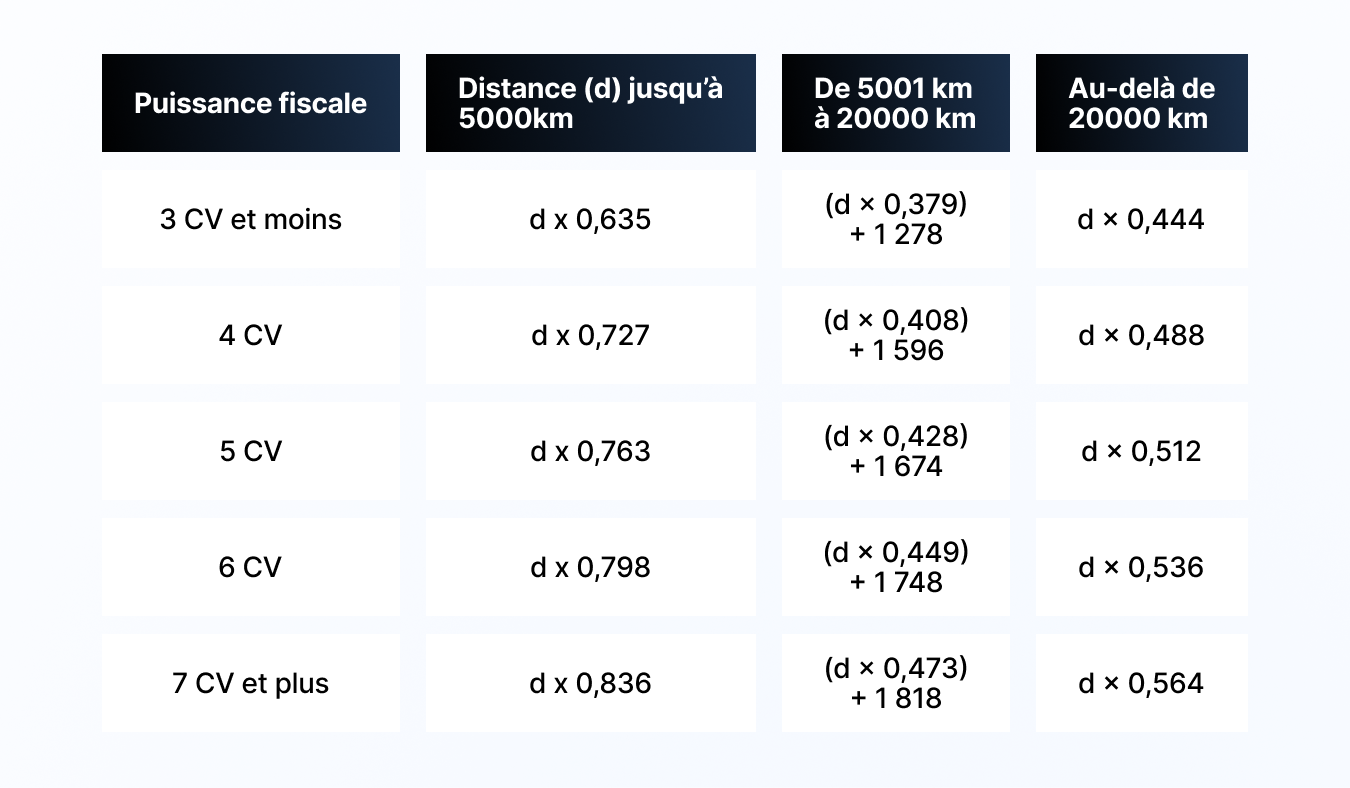
Here is the 2026 mileage scale applicable to combustion, hybrid and hydrogen cars, for the 2025 income tax return. The letter "d" represents the distance travelled for business during the year, in kilometres.
Let's take a concrete example. An employee travels 8,000 km for business during the year with a 6 hp car. They fall within the 5,001 to 20,000 km bracket, so the formula is (8,000 × 0.374) + 1,457, i.e. 4,449 euros in deductible actual expenses. Another case: a 5 hp vehicle used over 4,000 km gives a simple product, 4,000 × 0.636, i.e. 2,544 euros. Note that vehicles above 7 hp are treated as 7 hp for the calculation: fiscal power is capped at that bracket.
2026 mileage scale for electric cars
Since 2021, fully electric vehicles have benefited from a 20% increase on the calculated amount, a measure designed to encourage electric mobility. Plug-in hybrids are excluded. The table below already includes this 20% increase, so you do not need to add it a second time.
Taking the example of Marie, an employee who travels 12,000 km with a 5 hp electric car: the standard scale would give 5,679 euros, and the electric increase brings the deduction to 6,815 euros. For a taxpayer in the 30% bracket, this increase represents a real tax saving of around 341 euros per year. If your company is pursuing a transition towards a greener fleet, these amounts weigh in the trade-offs of your corporate travel policy.
2026 mileage scale for two-wheelers
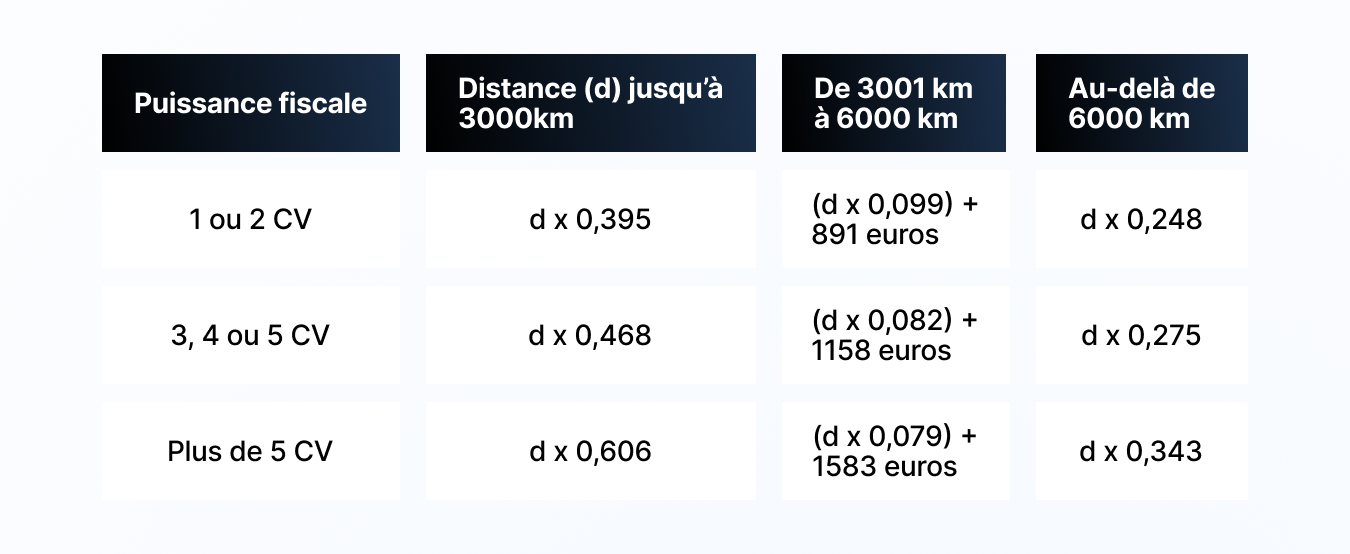
Motorcycles, meaning two-wheelers with an engine capacity above 50 cm³, have their own 2026 mileage scale, structured around brackets different from those for cars.
Mopeds, meaning two-wheelers with an engine capacity of 50 cm³ or less, fall under a single scale: d × 0.315 up to 3,000 km, (d × 0.079) + 711 from 3,001 to 6,000 km, and d × 0.198 above 6,000 km. Finally, bicycle journeys do not fall under the mileage scale but under the sustainable mobility package, with a bicycle mileage allowance of 0.25 euro per kilometre, capped at 200 euros per year within the actual expenses framework
How to calculate your 2026 mileage expenses step by step
Calculating your 2026 mileage expenses follows a simple logic. First identify the fiscal power of your vehicle in box P.6 of your registration document. Then count all your business kilometres for the year, meaning trips for missions, client visits, external meetings or training, excluding strictly personal journeys. Locate the corresponding mileage bracket, apply the formula from the table, then add the 20% increase if the vehicle is electric.
The scale already covers maintenance, wear, tyres, insurance and fuel, but some costs are added on the basis of supporting documents: tolls, parking and, in certain cases, loan interest linked to the vehicle purchase, in proportion to its business use. For home-to-work journeys, the authorities apply a limit of 40 kilometres per trip: beyond that, only 40 kilometres are taken into account, except in specific justified circumstances. If you prefer to avoid any manual calculation, the authorities provide an official mileage expenses simulator directly on impots.gouv.fr.
Actual expenses or the 10% deduction: how to choose
The actual expenses option, of which mileage expenses are a part, is only worthwhile if the total of your business expenses exceeds the 10% flat-rate deduction applied automatically by the authorities. For 2025 income declared in 2026, this deduction has a floor of 509 euros and a ceiling of 14,555 euros per person. The decision rule is straightforward: compare the amount of your actual expenses, including mileage allowances, with 10% of your net taxable salary. For a net taxable salary of 30,000 euros, the deduction represents 3,000 euros; your actual expenses must therefore exceed this threshold for the option to be worthwhile.
In practice, the profiles that benefit from choosing actual expenses are high-mileage drivers, owners of electric vehicles and lower-income employees with long commutes. Conversely, a high salary combined with a short commute generally makes the flat-rate deduction preferable. This choice is personal: within a couple filing jointly, each partner decides individually. Remember to keep all your supporting documents, logbook and mileage records, until the end of the authorities' recovery period: for 2025 income, at least until 31 December 2029.
The real lesson of the 2026 scale: a silent erosion
The striking fact about the 2026 mileage scale is not a figure, it is an absence. For the fourth consecutive year, the amounts have not moved, whereas the last revaluation, of 5.4%, dates back to 2023. Over the period, cumulative inflation is close to 8%. In other words, each business kilometre you declare is now reimbursed less, in constant euros, than it was three years ago. For the 2.5 million taxpayers who declare actual expenses, and for the companies that reimburse their staff on this basis, the apparent stability masks a real loss of purchasing power.
This is precisely where the distinction between mileage allowance and overall travel management becomes strategic. The mileage scale applies to the use of a personal vehicle, but the bulk of modern business travel goes through rail, air and hotels, where different cost and reimbursement logics apply. A department that optimises its travel does not simply follow a scale: it centralises booking, applies a clear travel policy and automates business travel expense reimbursement. This is the core of what a next-generation business travel agency like Fairjungle offers.
Integrating the mileage scale into a controlled travel policy
The 2026 mileage scale is a tax compliance tool, but it says nothing about budget control or traveller comfort. A company that lets everyone manage their allowances on their own exposes itself to inconsistent entries, missing receipts and impossible oversight. By centralising travel on a single platform, you gain a consolidated view of costs, automatic compliance control against internal policies and a radical simplification of expense reports, including mileage allowances.
This approach also has a duty of care dimension: knowing where your employees are, which modes of transport they use and at what real cost is as much a safety issue as a financial one. If you are preparing a consultation to structure your programme, our guide on the travel agency request for proposal sets out the method. And to see concretely how to automate the tracking of your teams' travel expenses, the simplest step is to book a Fairjungle demo.
In summary
The 2026 mileage scale carries over unchanged the amounts in force since 2023, for 2025 income declared in spring 2026. It is calculated from fiscal power and business mileage, with a 20% increase for electric vehicles, and is only worthwhile if your actual expenses exceed the 10% deduction capped at 14,555 euros. Beyond tax compliance, the real question for a company is overall control of its travel, an area where a dedicated platform brings far more than a simple scale.