Your travel policy compliance rate measures the share of bookings that follow company rules: channel, price caps, class, lead time and approval. To raise it for good, you need to work on two fronts. The tool makes the compliant option the easiest one to book. Management explains the rules, tracks deviations and frames exceptions.
This is not a theoretical problem. In a 2024 BCD Travel survey of more than 1,200 business travellers, over 95% knew where to find their travel policy. Yet more than two-thirds deviate from it at least occasionally (TourMaG). Knowing the rule is not enough to make people follow it.
A booking is compliant when it meets all the rules that apply: authorised booking channel, price cap, travel class, minimum lead time and approval where required. Breaking a single rule is enough to make it out of policy.
The compliance rate is one of the key indicators for managing business travel, alongside the tool adoption rate. Read the two together: an excellent compliance rate based on a small share of bookings leaves the rest of your spend out of sight. We cover these indicators in our article on business travel KPIs.
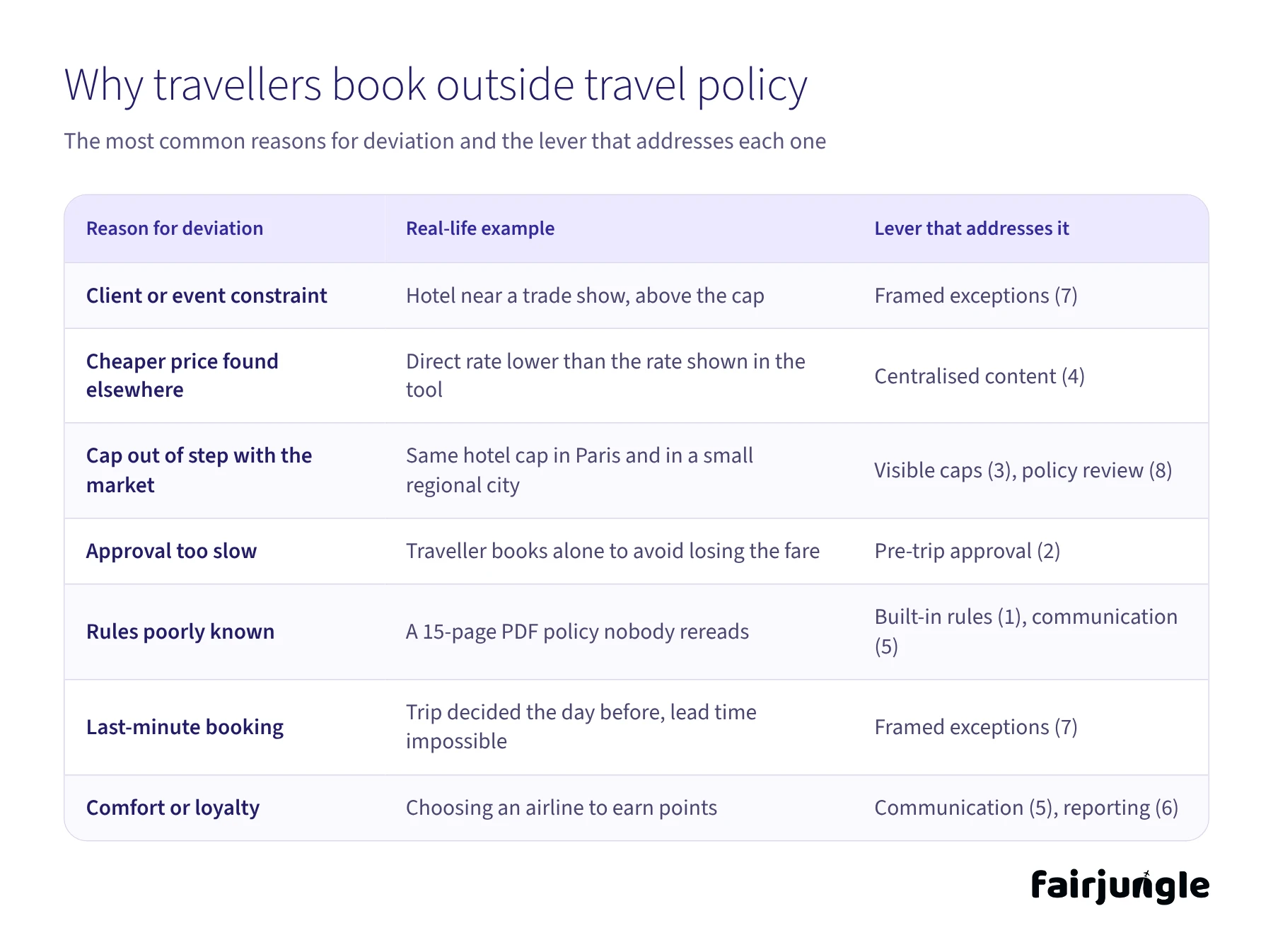
Why do travellers book outside travel policy?
Most deviations are not about cheating. They happen because a rule does not fit the situation, or because the compliant option is harder to find than the other one.
In the BCD Travel survey, the top reason for deviating is a client meeting that requires out-of-policy transport or accommodation (31%). Next come conferences and events that require non-preferred suppliers (28%). Not knowing the policy (6%) and loyalty programmes (5%) matter far less (Business Travel News Europe).
Hotels remain the weak spot. According to 2026 GBTA research, travel buyers estimate that on average 32% of hotel bookings are made outside managed channels (Hospitality.today).
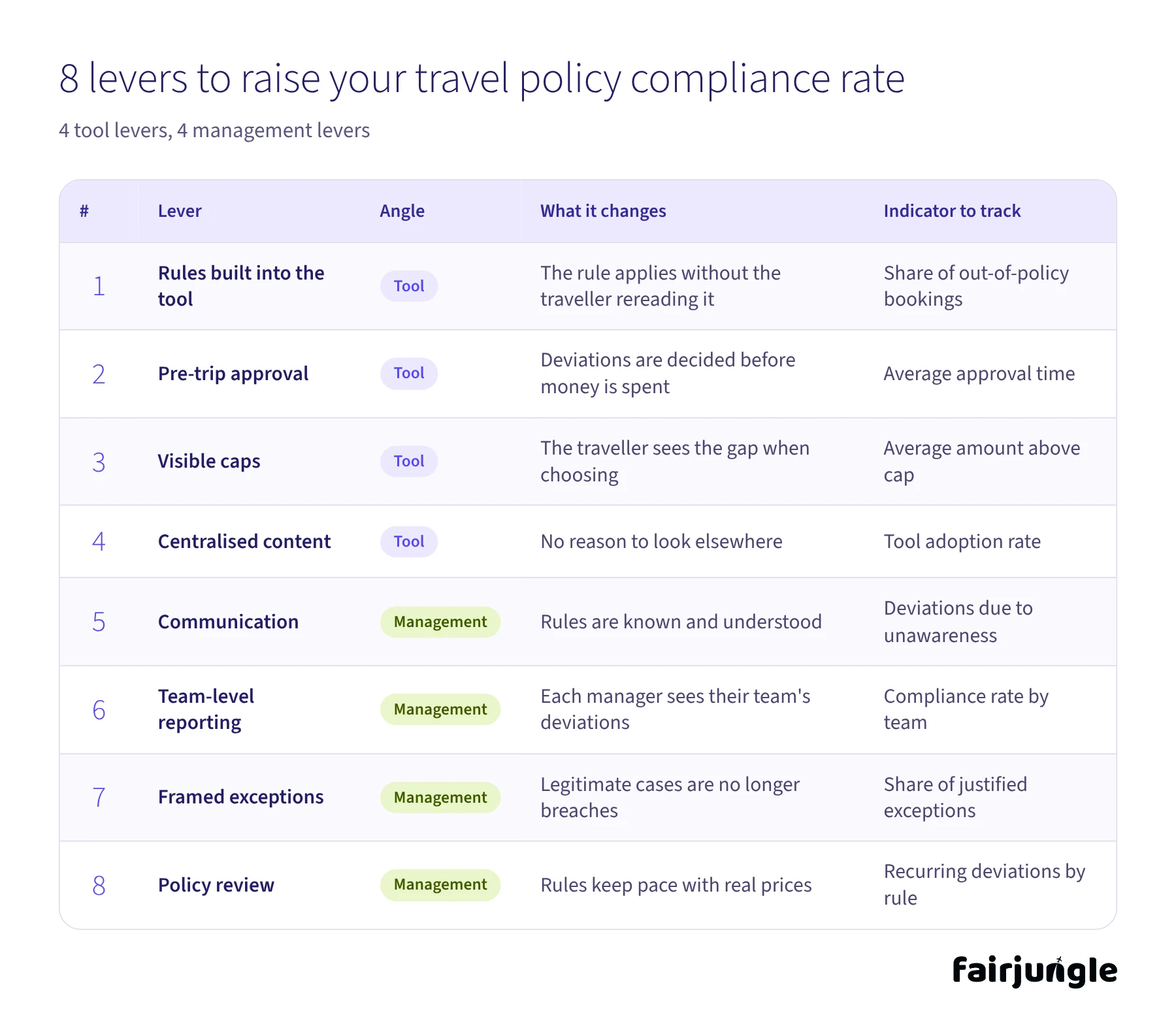
8 levers to raise your compliance rate
The first four levers are about the tool: they make the right booking easier than the wrong one. The next four are about management: they give the rules meaning and keep them up to date.
Lever 1: build the rules into your booking tool
A travel policy that lives in a PDF depends on travellers' memory. A policy configured in the tool applies itself: compliant options show first, the others are flagged or blocked.
This lever has the biggest impact because it works at the exact moment of decision. In Fairjungle, the travel policy is built into the booking flow. Rules can vary by destination, dates or traveller profile.
Lever 2: trigger approval before booking
Approval after the fact comes too late: the money is already spent. Pre-trip approval lets you decide on a deviation before the purchase.
To avoid slowing travellers down, trigger it only for out-of-policy bookings. Set up workflows that fit your organisation: by team, cost centre, country or amount. Set a response time too. An approver who answers in three days pushes travellers to book alone before the price goes up. On Fairjungle, approvers accept or decline in one click, including from the mobile app.
Lever 3: make caps visible at the moment of choice
A cap you cannot see is a cap you will exceed. Show it in search results, with the gap in euros for each option: “€35 above your cap” says more than a general rule.
Adapt caps to the market as well. A single hotel cap for a whole country is either too high in smaller cities or unrealistic in the capital. Caps by city, or adjusted to available prices, reduce unavoidable deviations.
Lever 4: centralise all travel content in one tool
A traveller who cannot find their train, hotel or fare in the tool will look for it elsewhere. They will then leave both the policy and the company's data.
Bring rail, air, hotels and car rental together on one platform, with your negotiated rates visible. The more complete the content, the weaker the “I found it cheaper elsewhere” argument becomes.
Lever 5: communicate the policy and explain the reasons
A rule people understand is better followed than a rule imposed on them. Explain why each rule exists: budget control, traveller safety, sustainability goals.
Present the policy as soon as someone joins. Offer a one-page summary alongside the full document. Announce every update and ask managers to relay the message. For the structure of the document, use our corporate travel policy guide.
Lever 6: track compliance by team
An overall compliance rate hides the gaps. Break it down by team, entity or cost centre, and share it every month with the managers concerned.
The goal is not to point fingers. It is to see where rules cause problems and discuss them with the right people. Add the main reasons for deviation to each figure: that is where the actions are.
Lever 7: frame exceptions
Some deviations are legitimate: a late client meeting, a trade show, a safety constraint, an accessibility need. Banning them only pushes people to work around the rules. It is better to plan for them.
List the exception cases in your policy. Require a reason for every out-of-policy booking and have it approved. You turn an unmanaged deviation into a documented decision you can analyse later.
Lever 8: review the policy using your data
If the same rule is broken again and again, the rule itself is often badly calibrated. When half of all hotel nights in a city exceed the cap, the traveller is not the problem.
Review the policy at least once a year, based on recurring deviations by rule. Recognise good behaviour too: making savings visible, or sharing part of them with teams, strengthens buy-in.
How do you measure your compliance rate?
The calculation is simple: divide the number of compliant bookings by the total number of bookings, then multiply by 100. For example, 412 compliant bookings out of 480 give a rate of 85.8%.
To make this figure useful, take four precautions:
Define what counts as compliant. Use three statuses: compliant, approved out of policy, unapproved out of policy. An approved exception does not mean the same thing as a workaround.
Break it down by category and team. Air, rail and hotel go off track for different reasons.
Track it monthly. The trend matters more than any single month.
Read it alongside the tool adoption rate. Bookings made outside the tool are missing from the calculation.
There is no reliable public benchmark for this rate. Your own history remains the best reference. Formulas and the other indicators to track are covered in our article on the 12 business travel KPIs.
Travel policy compliance FAQ
What is a good travel policy compliance rate?
There is no reliable public standard. Measure your rate for three months, then set an improvement target by category (air, rail, hotel). Compare yourself with your own history rather than with a generic figure.
Should you block out-of-policy bookings?
Not always. Block clear-cut cases, such as an unauthorised class on a short trip. For grey areas, such as a small overspend on a cap, pre-trip approval with a stated reason works better.
What should you do when an employee books out of policy?
Start by understanding the reason: it often points to a rule that does not fit. If it keeps happening without good reason, involve the manager. Refusing reimbursement should remain a last resort, written clearly into the travel policy.
Is an approved out-of-policy booking compliant?
It depends on your definition. The clearest option is to track it separately, under an “approved out of policy” status. You keep an honest compliance rate while measuring the weight of exceptions.
What is the difference between compliance rate and adoption rate?
The adoption rate measures the share of bookings made through the company tool. The compliance rate measures the share of those bookings that follow the policy. The first determines how reliable the second is.
How often should you review your travel policy?
At least once a year, and whenever the data shows a recurring deviation on a rule. Our corporate travel policy guide explains what it should include.
Is a travel management tool enough to guarantee compliance?
No. The tool makes the right booking easier and deviations visible. But without communication, follow-up by managers and realistic rules, travellers will keep working around the policy.
Travel policy compliance: key takeaways
Compliance rises when the right option becomes the easiest one to book and when the rules make sense to the people who travel. Build the policy into the tool, approve before money is spent, show caps and centralise content. On the management side, explain, measure by team, frame exceptions and adjust rules based on data.
Want to see how Fairjungle applies your travel policy directly in the booking flow? Book a demo with our team.