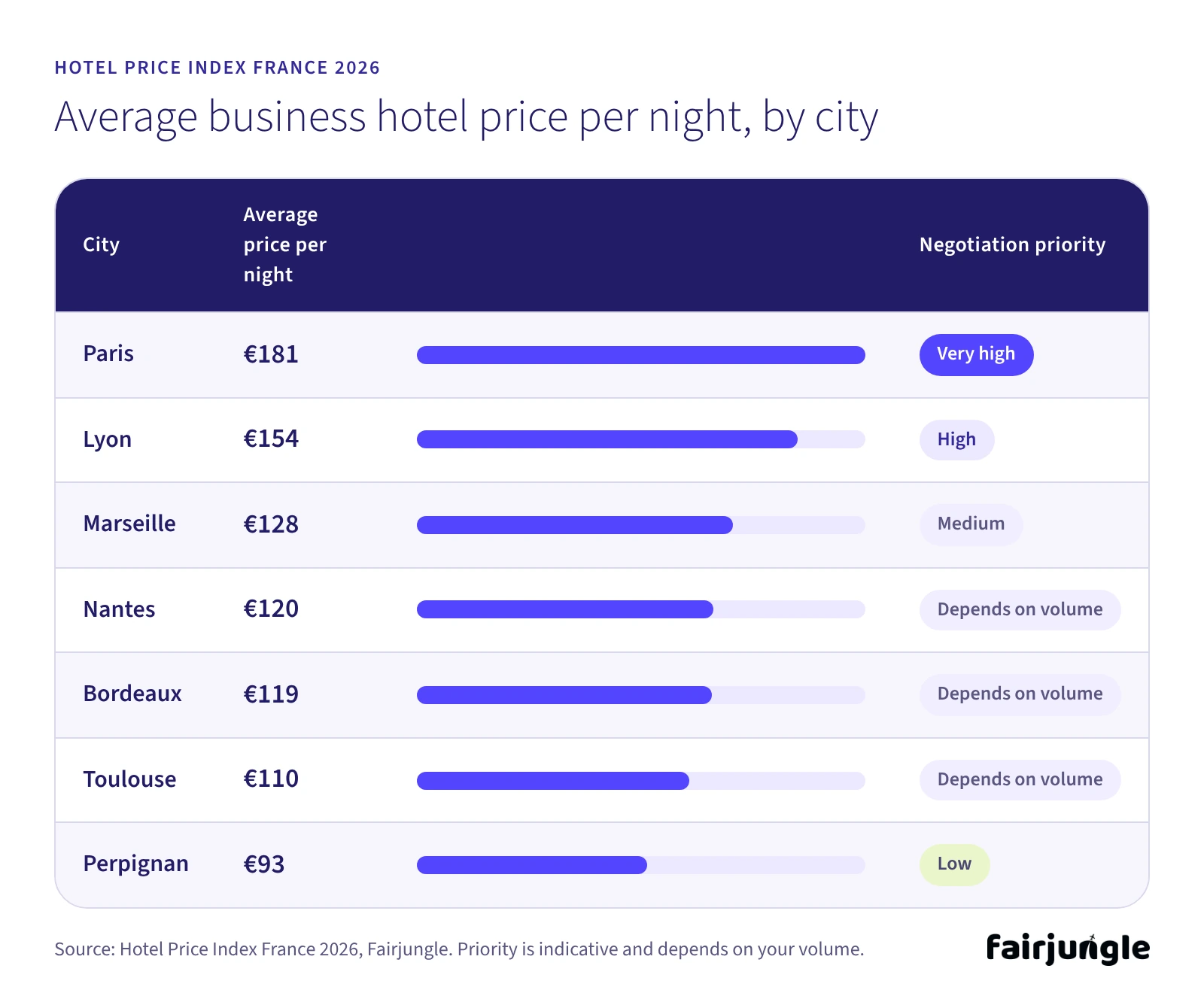
Negotiating hotel rates pays off when a company concentrates regular room nights in a few expensive cities, such as Paris (€181 per night on average) or Lyon (€154). Elsewhere, agency rates and a well-tuned hotel policy often do better than a contract. This guide draws on Fairjungle's Hotel Price Index France 2026, built from the bookings of more than 300 companies and over 10,000 business travellers.
Key takeaways
The median price of a business hotel night in France is €117, and 57% of bookings fall between €90 and €150.
A night in Paris costs almost twice as much as a night in Perpignan: that is where negotiation pays off most.
Prices peak in May and June and bottom out in July, with a gap of around 12%.
In the same hotels, prices fell by around 1.4% between Q1 2025 and Q1 2026: a fixed negotiated rate can quickly end up above the public rate.
Clauses (cancellation, breakfast, late check-out) are often worth as much as the discount itself.
Why negotiate hotel rates in 2026?
Accommodation weighs heavily on a travel budget, and price gaps are wider than many companies assume. According to the Fairjungle index, the median stands at €117 per night, but 8% of bookings exceed €200. The €90 to €120 band alone accounts for around a third of room nights.
The market is not overheating. In the same hotels, prices dipped slightly (around -1.4%) between Q1 2025 and Q1 2026, with contrasting trends from city to city. Negotiation is therefore not about shielding yourself from a general price surge. The goal is to pay the right price where your employees actually stay, and to secure better terms.
Spending also varies by function. Sales and Marketing teams spend €155 per night on average, compared with around €125 for Operations, a gap of nearly €30. A deal with the hotels your sales team uses can therefore matter more than a general agreement.
Negotiation is one of the levers covered in our guide to cutting business travel costs. It works best when it is grounded in your own booking data.
When to negotiate: volume, cities and season
A hotelier grants a corporate rate in exchange for visibility on regular room nights. Before you call, you need to know where, when and how much your travellers stay.
Volume: start from the last 12 months
Extract your room nights by city and by hotel over a rolling year. Good candidates for negotiation tick three boxes:
recurring room nights in the same hotel or neighbourhood, all year round;
an average rate paid above the city benchmark;
bookings spread across several properties that you could consolidate into one or two hotels.
Your bargaining power comes less from your total volume than from your ability to steer it. A deal is only worth something if your travellers actually book the hotel.
Cities: target expensive markets first
The gaps between cities are large. The average price of a business night ranges from €93 in Perpignan to €181 in Paris.
Several major destinations cluster around €110 to €125. In these markets, a discount of a few euros makes little difference: the included terms matter more.
Season: negotiate before the spring peak
Prices are higher in spring, peaking in May and June. They fall over the summer, hit their low point in July, then rise again around September. The May peak is around 12% above the July low.
Two practical consequences:
start negotiating in the autumn or early in the year, so the deal is live before May;
secure availability during busy months, because that is when a negotiated rate without a room guarantee lets you down.
Weekday or weekend: each city has its own profile
Nationally, the gap between weekday and weekend prices is small (-0.7%). But cities behave very differently:
in business hubs, prices drop at weekends: -20% in Rennes, -19% in Lyon, -19% in Courbevoie;
in more leisure-oriented cities, they rise: +14% in Perpignan, +13% in Aix-en-Provence, +12% in Avignon.
In Lyon or Rennes, focus on the weekday rate, which is the one your travellers pay. In leisure cities, ask for the same rate on Friday and Saturday if your teams stay over the weekend.
Length of stay: ask for a long-stay rate
Long stays hardly trigger any automatic discount. Up to 7 nights, the index shows no significant reduction. Between 8 and 14 nights, the price drops by only around 4% compared with a single night. If you send consultants or technicians on assignments lasting several weeks, negotiate a separate long-stay rate.
Negotiated rate vs public rate: what is the difference?
The public rate, or rack rate, is the base price a hotel displays before any discount or promotion. In practice, few guests pay it: hotels mostly sell at the day's best available rate, which moves with demand.
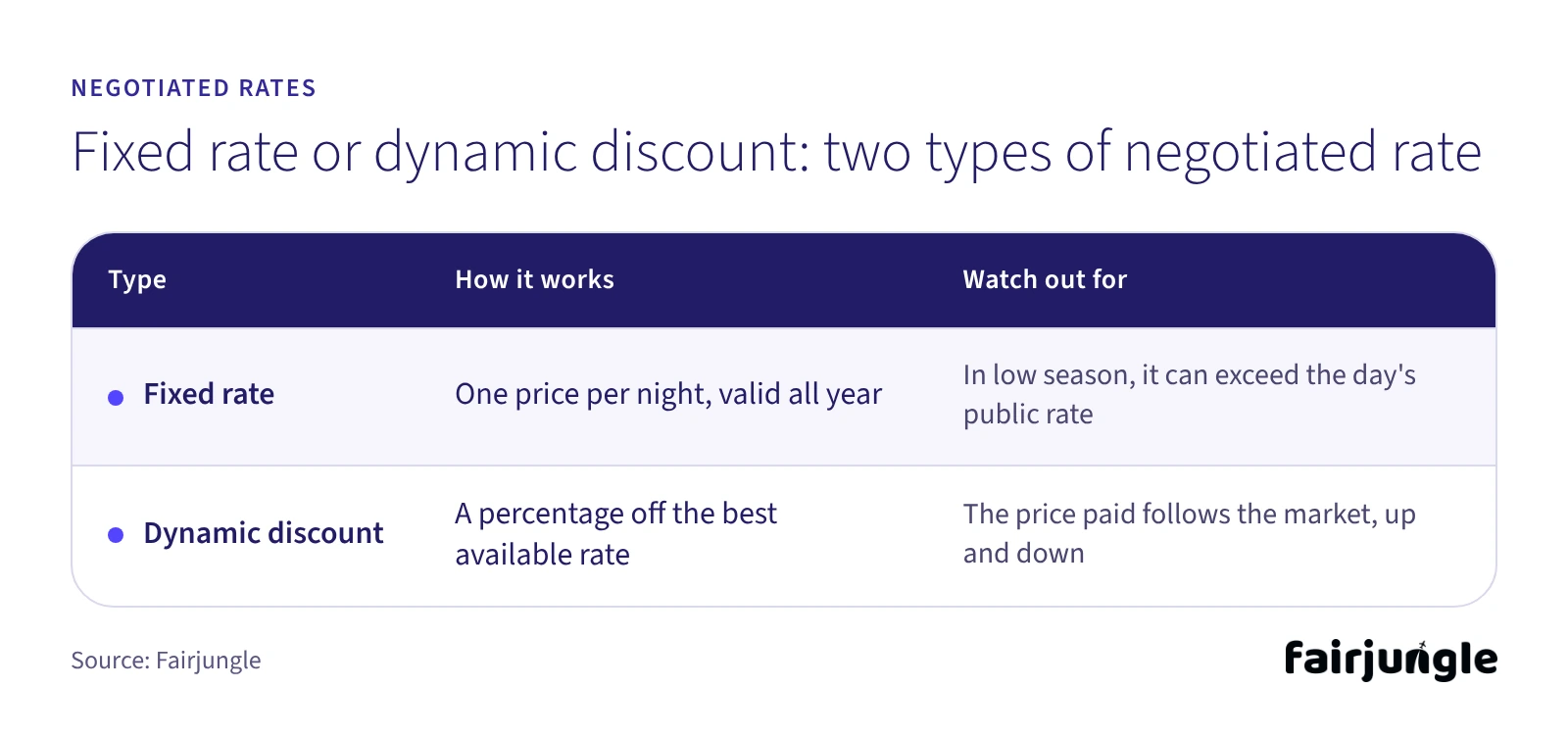
A negotiated rate is a price reserved for your company, set by contract for a given period. It usually takes one of two forms:
The index data illustrates this risk. Between the May peak and the July low, prices vary by around 12%. A fixed rate set on spring prices can therefore cost more than the public rate in summer.
The fix: ask that your travellers always pay the lower of the two, the negotiated rate or the best public rate available at the time of booking. Failing that, systematically compare both before booking.
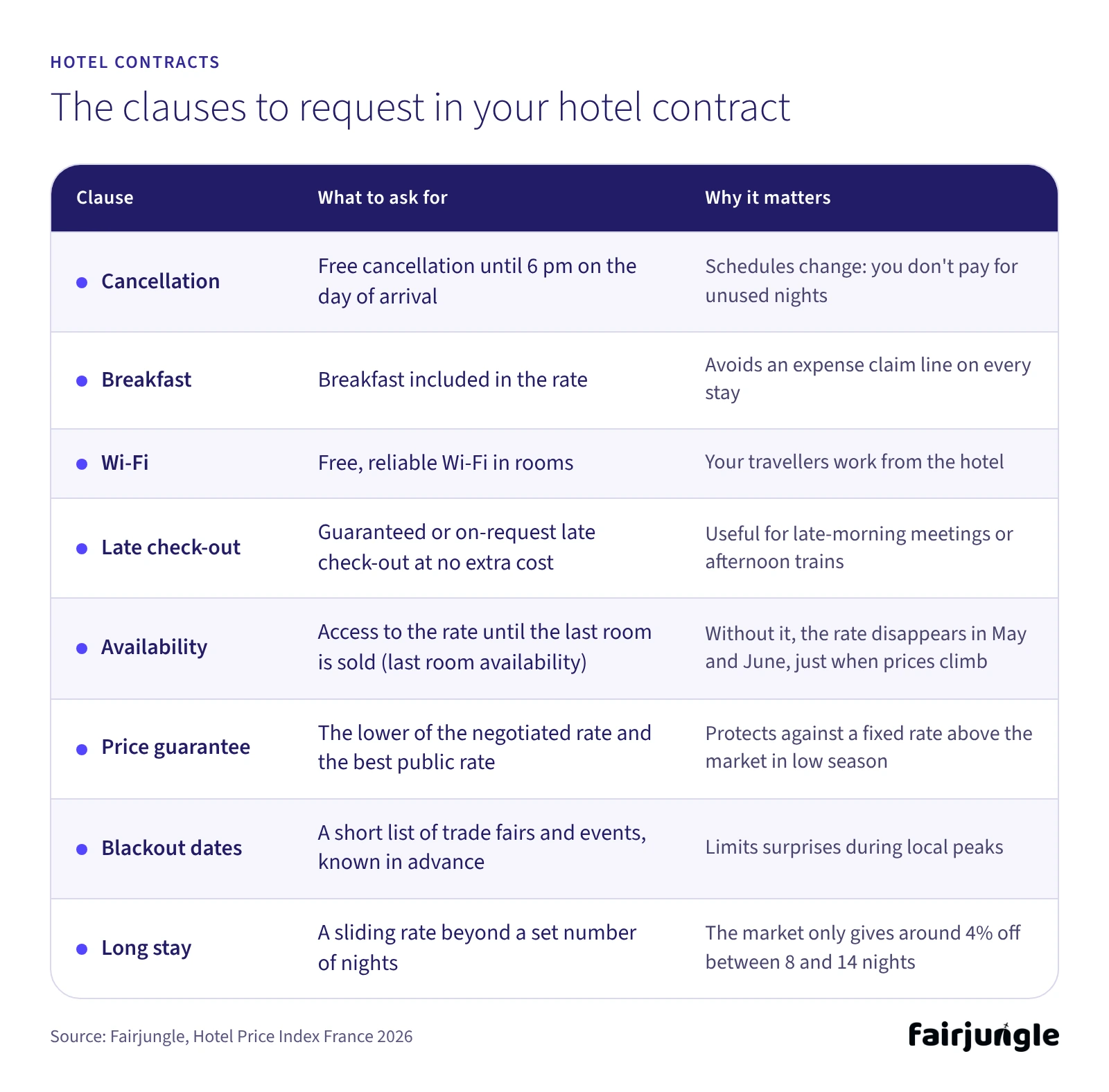
The clauses to request in your hotel contract
A discount counts for little if breakfast is charged separately or a late cancellation is billed in full. In markets around €110 to €125 per night, included benefits often make the difference.
Get these terms in writing, along with the contract's validity period and the room categories covered.
How to track your negotiated rates
A negotiated rate that goes unused, or is poorly loaded into the booking tool, brings in nothing. Tracking comes down to five indicators, reviewed every quarter:
Utilisation rate: the share of room nights in a city booked at contracted hotels. A low rate points to a poorly located hotel or a travel policy that doesn't steer travellers to it.
Average rate paid per city, compared with the index benchmark (€181 in Paris, €154 in Lyon, €128 in Marseille).
Gap with the public rate at the time of booking, to check that the negotiated rate is still the best, especially in July.
Rate availability: refusals or cases where the rate does not show up, particularly in May and June.
Out-of-channel bookings: nights booked directly or on consumer sites, which escape the deal and your reporting.
These figures also form the basis of your annual renegotiation. With a tool like Fairjungle, your negotiated rates are loaded into the platform, applied automatically and tracked in reporting, alongside your other business travel KPIs.
Volume too low? Alternatives to direct negotiation
An SME sending a few travellers a month to a variety of cities will struggle to secure a contract. It can still pay less than the public rate.
Agency rates. A business travel agency pools the volume of hundreds of companies and negotiates on their behalf. With Fairjungle, your travellers get access to Fairjungle's negotiated rates, on top of any rates your company has secured itself.
Hotel chains' loyalty and corporate programmes. Many hotel groups offer programmes for small businesses with no volume commitment. Their benefits often relate to terms: breakfast, late check-out, flexible cancellation.
Multi-source comparison. The same hotel can be sold at different prices depending on the channel. A tool that compares several inventory sources finds the best price for every booking.
City caps in your travel policy. Setting caps based on the index benchmarks (for example around the €117 median in the regions, higher in Paris and Lyon) limits overspending without a contract.
Gradual consolidation. Steering travellers towards two or three hotels per city they already use builds the volume that will let you negotiate next year.
What volume do you need to negotiate a hotel rate?
There is no universal threshold. What matters is how regularly you book nights in the same hotel and your ability to steer travellers there. Start with the cities where you stay most often and where prices are high, such as Paris (€181 on average) or Lyon (€154).
What hotel budget should you plan for a business trip in France?
The median price is €117 per night in 2026, and 57% of bookings fall between €90 and €150. Gaps between cities are large: from €93 in Perpignan to €181 in Paris.
When should you negotiate hotel rates?
Ideally in the autumn or early in the year, so the deal is in place before the May-June peak. That is when prices are highest, around 12% above the July low.
What is the difference between the rack rate and a negotiated rate?
The rack rate is the hotel's base public rate, before any discount. A negotiated rate is reserved for your company by contract, as a fixed price or as a discount on the best available rate.
Is a negotiated rate always cheaper than the public rate?
No. A fixed rate can exceed the day's public rate, particularly in low season. Ask for a clause guaranteeing the lower of the two, and monitor the gap in your reporting.
What if my company doesn't travel enough to negotiate?
Use an agency's negotiated rates, hotel chains' corporate programmes and city caps in your travel policy. Consolidating your nights in a few hotels lays the groundwork for a future negotiation.