Hotel accommodation represents a significant share of corporate travel budgets. But how much should companies actually budget for a hotel night during a business trip in France in 2026?
Using booking data from more than 300 companies and over 10,000 business travellers, Fairjungle analysed 12 months of activity across 20 major French cities to understand the hotel prices companies are actually paying.
The first takeaway is clear: the French business hotel market remains relatively stable overall, but prices vary significantly depending on the city, the timing of the trip and the traveller profile.
What hotel budget should companies plan for business travel in France?
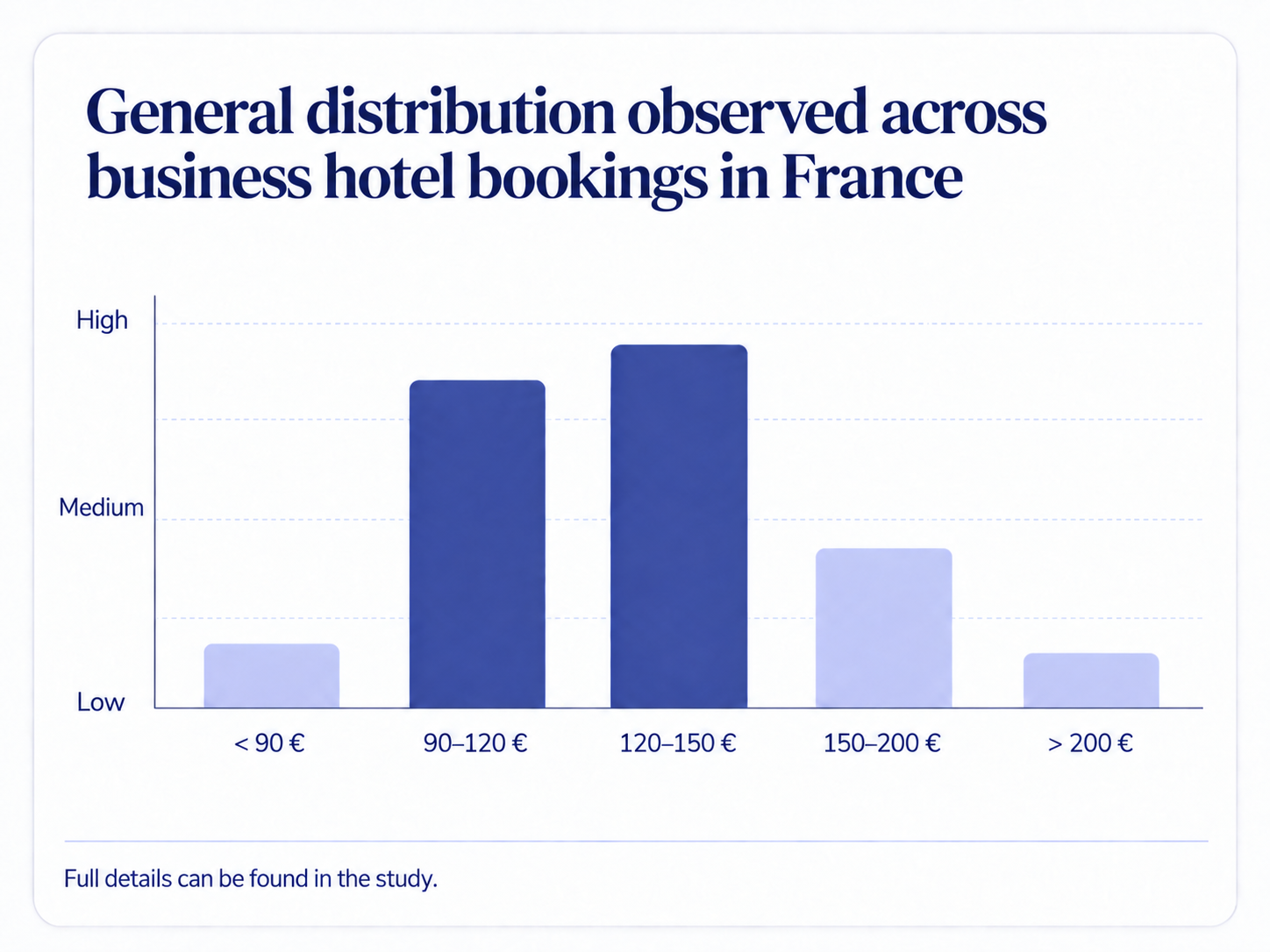
Most business hotel bookings in France fall between €90 and €150 per night.
According to Fairjungle's analysis, the median hotel rate is €117 per night, while 57% of the bookings analysed fall between €90 and €150. The €90–€120 segment alone accounts for around one in three bookings.
Higher rates remain relatively uncommon: only 8% of bookings exceed €200 per night, while just 0.5% are above €350.
These figures provide companies with a useful benchmark, but they should not be treated as a single nationwide hotel cap. Hotel rates can vary considerably between major metropolitan areas and smaller cities.
The appropriate hotel budget therefore depends heavily on the destination.
Which French cities are the most expensive for business travel?
Paris is by far the most expensive destination among the major business cities analysed.
The average hotel rate reaches €181 per night in Paris, compared with €154 in Lyon, €128 in Marseille, €120 in Nantes, €119 in Bordeaux and €110 in Toulouse.
At the other end of the ranking, Perpignan averages €93 per night. A hotel night in Paris is therefore almost 1.9 times more expensive than in Perpignan.
The French business hotel market can be divided into several pricing tiers. Paris operates in a category of its own, some major cities sit within a higher price bracket, while many of France's main business destinations cluster around €110 to €125 per night.
For companies, this raises a practical question: should the same hotel cap apply in Paris, Lyon, Toulouse and Nantes?
A uniform corporate travel policy may either become too restrictive in expensive cities or allow unnecessary overspending in more affordable markets.
The full ranking of France's major business destinations provides a more detailed comparison.
When are hotels most expensive for business travellers in France?
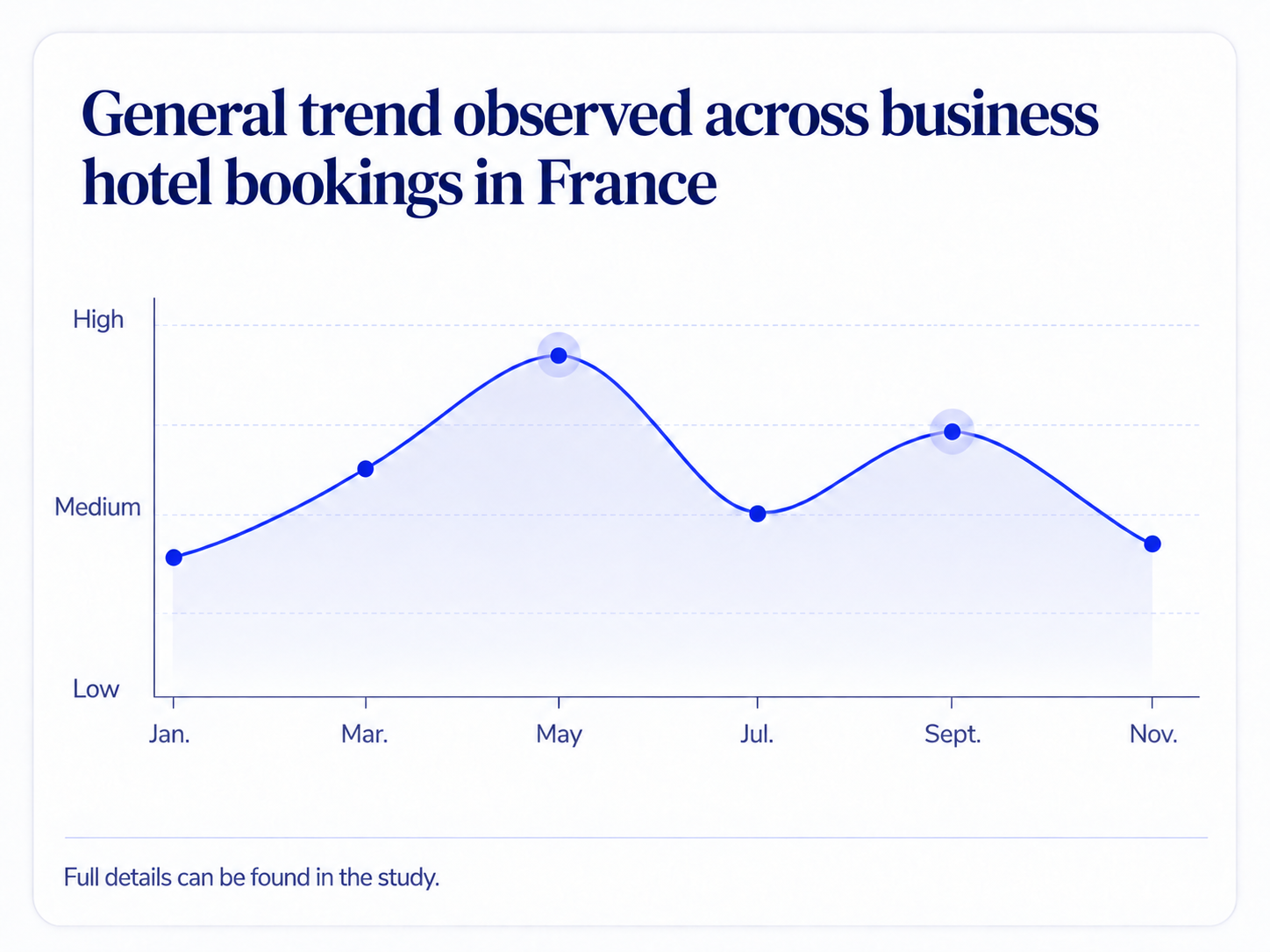
Business hotel rates are generally higher in spring, with a peak around May and June.
Fairjungle's analysis shows a relatively consistent seasonal pattern across major French cities: hotel prices rise during spring, decline during the summer and increase again around September.
The difference is meaningful: the peak observed in May is around 12% higher than the low point recorded in July.
A hotel spending cap that works well during a quieter period may therefore become much harder to comply with only a few months later.
A corporate travel policy that reflects real market conditions should take into account both the destination and seasonality.
Are hotels cheaper at weekends in France?
Not necessarily: the national difference is small, but the gap can become significant in individual cities.
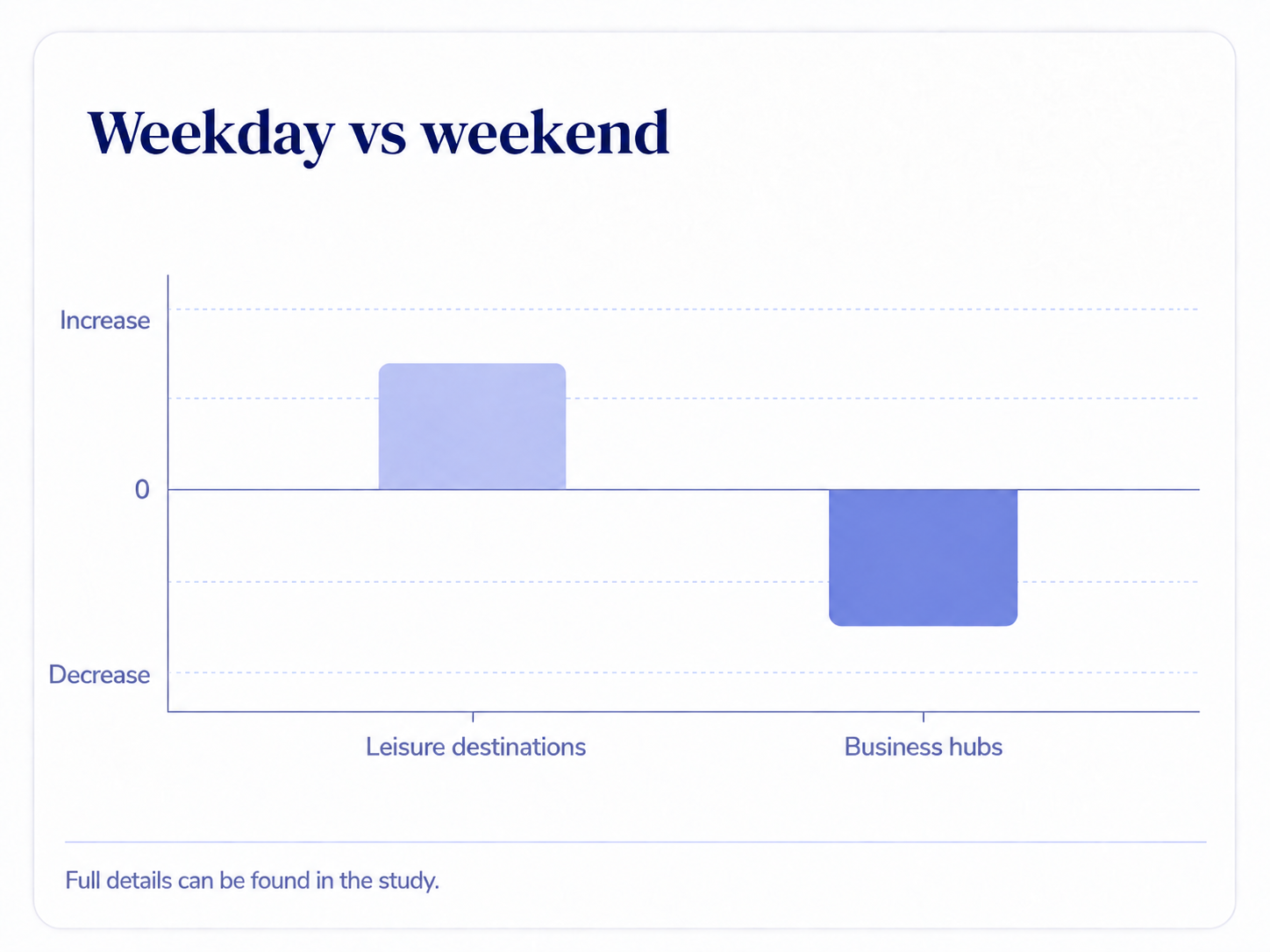
Across the market analysed, the average difference between weekday and weekend rates is just −0.7%.
However, this national average hides very different local patterns.
In some leisure-oriented destinations, hotel rates increase at weekends: +14% in Perpignan, +13% in Aix-en-Provence and +12% in Avignon.
By contrast, rates fall sharply in several business hubs when corporate demand decreases: −20% in Rennes and −19% in both Lyon and Courbevoie.
For business trips with some date flexibility, choosing the right days to stay can therefore become a genuine cost-optimisation lever.
Do longer business trips lead to lower hotel rates?
Only marginally: for most business stays, length of stay has a limited impact on the nightly rate.
When comparing the same hotels, the analysis shows no significant discount for stays of up to seven nights. For stays of 8 to 14 nights, the price index falls from 100 to 96, representing a saving of around 4% compared with a one-night stay.
This part of the analysis covers more than 21,000 bookings across over 1,500 comparable hotels.
In other words, staying longer does not automatically lead to a significantly lower nightly rate.
For companies seeking to reduce accommodation spend, hotel selection appears to have a greater impact than length of stay itself.
Are business hotel prices increasing in France in 2026?
No, not at national level.
When comparing the same hotels, rates decline slightly between the first quarter of 2025 and the first quarter of 2026, by around −1.4%.
However, this overall stability hides very different local trends. Some cities are experiencing price increases while others are seeing hotel rates decline.
For Travel Managers, monitoring a national average is therefore not enough. City-level hotel pricing provides a more relevant benchmark for adjusting corporate hotel caps.
Do all teams within a company spend the same amount on hotels?
No. Average hotel spend varies significantly depending on business function.
Sales and Marketing teams average €155 per night, around 27% above the national average.
Finance and HR follow at €144 per night, Engineering at €141, while Operations teams average around €125 per night.
The difference between the highest- and lowest-spending functions therefore reaches approximately €30 per night.
For companies, these differences can help identify traveller populations where booking behaviour and corporate travel rules may require closer analysis.
How should companies adapt their hotel travel policy in 2026?
There is no single hotel cap that accurately reflects the entire French business travel market.
Destination remains one of the main pricing factors, but it is not the only one. Seasonality, the days of the stay and traveller profile can also have a meaningful impact on the final rate paid.
A corporate travel policy that is too uniform can create two opposite problems: unnecessarily restricting bookings when market prices are high or allowing excessive spend when cheaper options are widely available.
The challenge is instead to introduce hotel spending caps that reflect actual market conditions, taking into account both the destination and changes in hotel prices over time.
How much do business hotels really cost in your city?
The 2026 analysis is based on booking data from more than 300 companies, over 10,000 business travellers, 12 months of activity and 20 major French cities.
The full study reveals:
how France's major business destinations rank by average hotel price;
the actual rates observed in each city;
the most and least expensive periods of the year;
how business hotel prices changed between 2025 and 2026;
the real impact of length of stay;
the difference between weekday and weekend pricing;
how hotel spend varies across different traveller populations.




.png)


