Accommodation represents a significant share of business travel budgets across Europe. But how much should a company actually budget for a hotel night on a business trip in Europe in 2026?
Based on several thousand bookings made by business travellers across major European cities outside France, we analysed the key trends shaping the B2B hotel market: price levels, differences between cities, seasonality and weekday versus weekend rates.
The first key finding is clear: the European hotel market is highly fragmented. Behind an overall price level that is higher than in France, there are significant differences depending on the destination and the time of travel.
What hotel budget should companies plan for business travel in Europe?
The core of the European business hotel market sits at a higher price level than in France.
A large share of bookings falls within an intermediate range of around €120 to €180 per night, while hotel stays costing more than €200 represent a larger share of bookings than in France.
However, this European average should only be used as a benchmark.
Hotel prices can vary significantly from one destination to another. A travel policy based on the same hotel spending cap across Europe may therefore fail to reflect actual local market conditions.
Which European cities are the most expensive for business travel?
Hotel prices vary considerably across Europe’s main business destinations.
The most expensive destinations include several Northern European capitals and major economic hubs, where average hotel rates can sit well above the core market range. By contrast, a number of cities in Central and Southern Europe remain significantly more affordable.
Between the highest- and lowest-priced destinations, the average cost of a hotel night can vary by more than twofold.
For companies operating across several European countries, this raises a practical question: does it really make sense to apply the same hotel cap in Copenhagen, Milan, Madrid, Lisbon and Warsaw?
The full ranking provides a detailed comparison of Europe’s main business destinations rather than relying solely on a continental average.
When are hotels most expensive for business travellers in Europe?
The timing of a trip also plays an important role in hotel prices.
The data shows greater seasonality and volatility than in France, with several price movements throughout the year and significant differences between cities. Some destinations experience their highest prices in spring, while others peak after the summer or during the autumn.
In other words, a hotel cap that works well during a quieter period can become much harder to respect when demand increases.
For Travel Managers, destination should therefore not be the only consideration. Seasonality is also an important factor when setting realistic hotel budgets.
Are hotels cheaper at weekends in Europe?
There is no single answer.
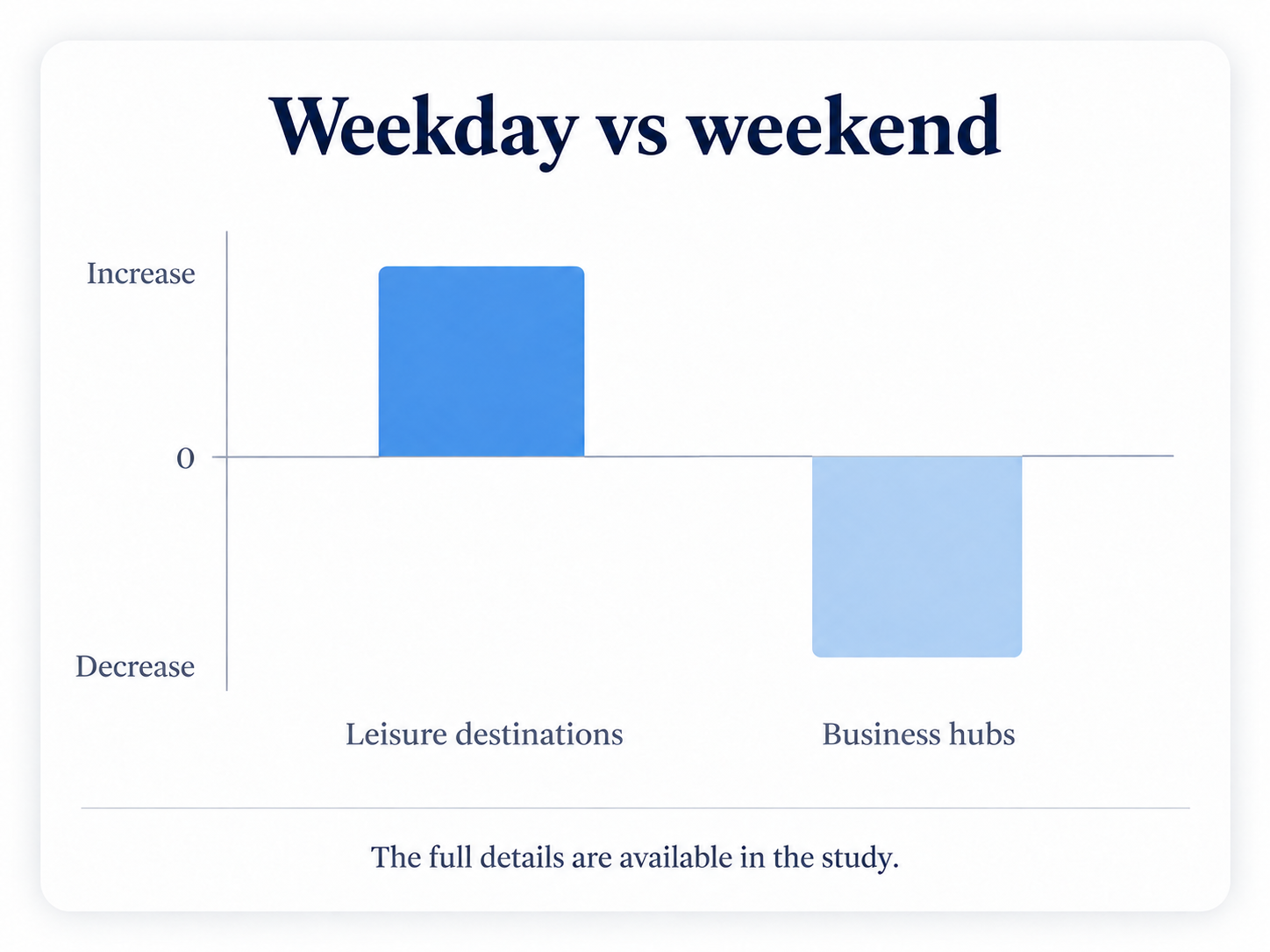
At European level, the average difference between weekday and weekend hotel prices appears relatively limited. However, this average hides very different patterns depending on the type of destination.
In major business hubs that rely heavily on corporate demand, hotel prices can fall sharply at weekends when business travel slows down. By contrast, highly touristic destinations can become more expensive as leisure demand takes over.
For business trips with some flexibility, the days selected for the stay can therefore become a genuine cost-optimisation lever.
Are business hotel prices increasing everywhere in Europe in 2026?
No. Price trends vary significantly from one destination to another.
Some cities are experiencing strong increases, while others are seeing hotel rates decline.
Like-for-like hotel analysis also shows that overall trends should be interpreted carefully, as the number of hotels that can be directly compared between the two periods remains limited in some destinations.
For companies, monitoring only a European average can therefore be misleading. City-level and local market data generally provide a more relevant benchmark.
Why do hotel prices vary so much between European cities?
The European hotel market does not operate as one homogeneous market.
Some destinations have strong corporate demand and therefore record high weekday rates. Others combine business and leisure demand, which can significantly change pricing patterns depending on the season and the day of the week.
These differences explain why two otherwise similar business trips can result in very different hotel budgets depending on the destination.
For companies, the objective should therefore not necessarily be to define one Europe-wide hotel cap, but rather to use sufficiently detailed benchmarks that reflect local market conditions.
How should companies adapt their hotel travel policy for business travel in Europe?
A European travel policy that is too uniform can quickly become ineffective.
A hotel cap that is too low may unnecessarily restrict the available inventory in the most expensive markets. On the other hand, a cap that is too high may allow bookings well above market rates in more affordable destinations.
A policy that is better aligned with real market conditions can take into account the destination, the season and the demand profile of each city.
This makes it possible to maintain cost control without unnecessarily limiting travellers’ options.
How much do business hotels really cost in Europe’s main cities?
Our 2026 study is based on bookings from several hundred companies and thousands of business travellers across major European destinations outside France.
It provides detailed insight into:
the European cities where business hotels are the most expensive;
price differences between major business destinations;
the real distribution of hotel prices per night;
the periods when hotel prices are under the greatest pressure;
weekday versus weekend pricing patterns;
hotel price trends observed between 2025 and 2026.