Measuring the carbon footprint of business travel has become an important priority for companies. But what are the main sources of emissions within a corporate travel programme?
Based on travel data from more than 300 companies and nearly 20,000 business travellers, Fairjungle analysed the key carbon trends shaping business travel in 2026.
The first finding is clear: there is no single “typical” carbon footprint for a business traveller. Industry sector, destinations and, above all, the modes of transport used can create significant differences between organisations.
What is the average carbon footprint of a business traveller?
Across the companies analysed, the annual carbon footprint is around 0.4 tonnes of CO₂ per active business traveller.
However, this average should be interpreted with caution.
Two companies with the same number of travellers can have very different carbon footprints depending on their activity, destinations and the proportion of trips taken by air.
The value of a carbon benchmark therefore lies not only in knowing the overall average, but also in being able to compare a company’s Travel programme with organisations that have a similar mobility profile.
Which mode of transport generates the most business travel emissions?
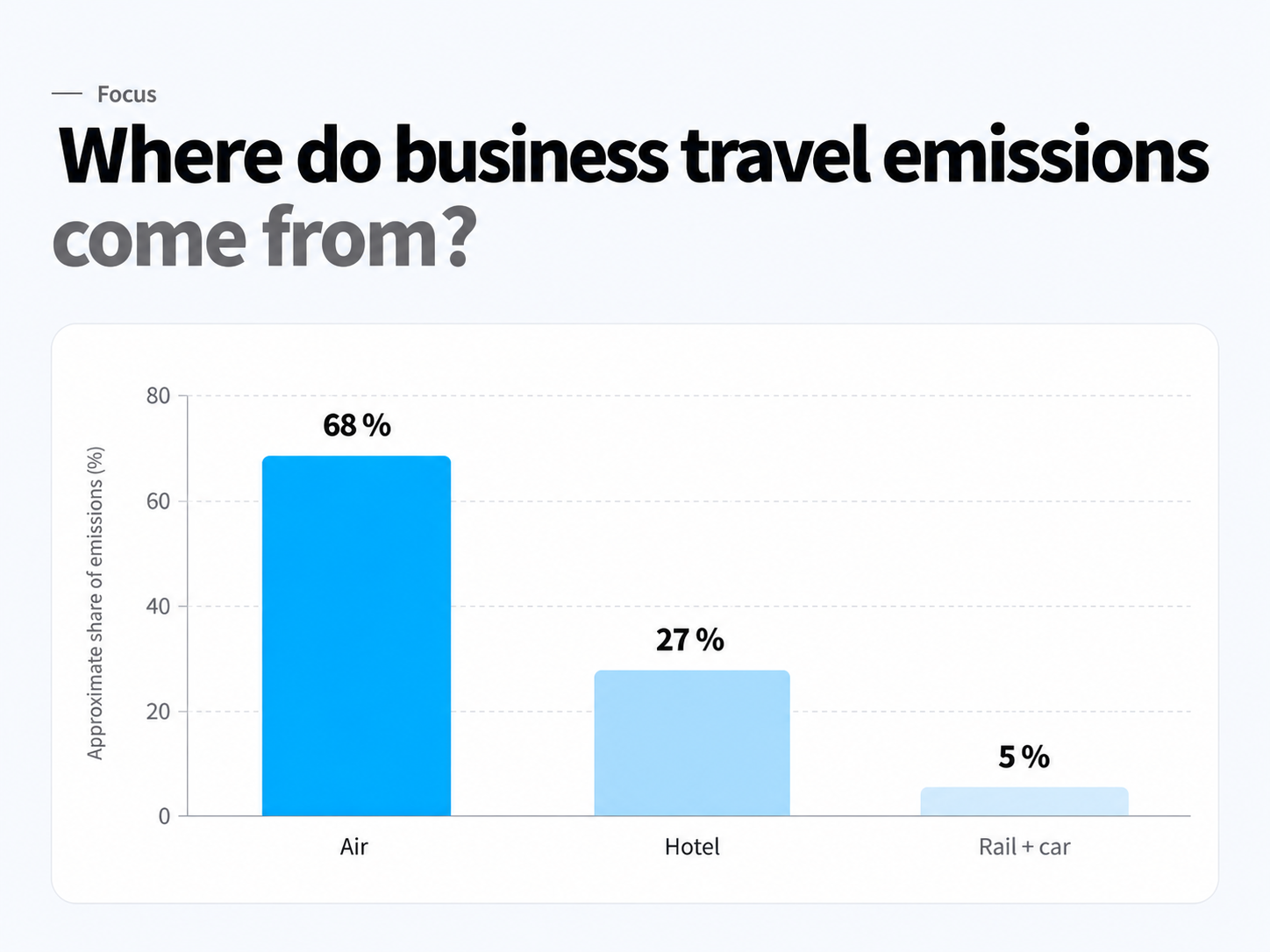
Air travel remains by far the largest source of emissions from business travel.
In the Fairjungle panel, nearly 7 out of 10 emissions come from flights. Accommodation represents just over a quarter of the total carbon footprint, while rail and car travel account for a much smaller share.
This means that a carbon reduction strategy cannot rely on reporting alone. It must also influence transport choices at the time of booking.
Does industry sector have a greater impact on carbon footprint than company size?
Yes. This is one of the main findings of the 2026 Business Travel Carbon Barometer.
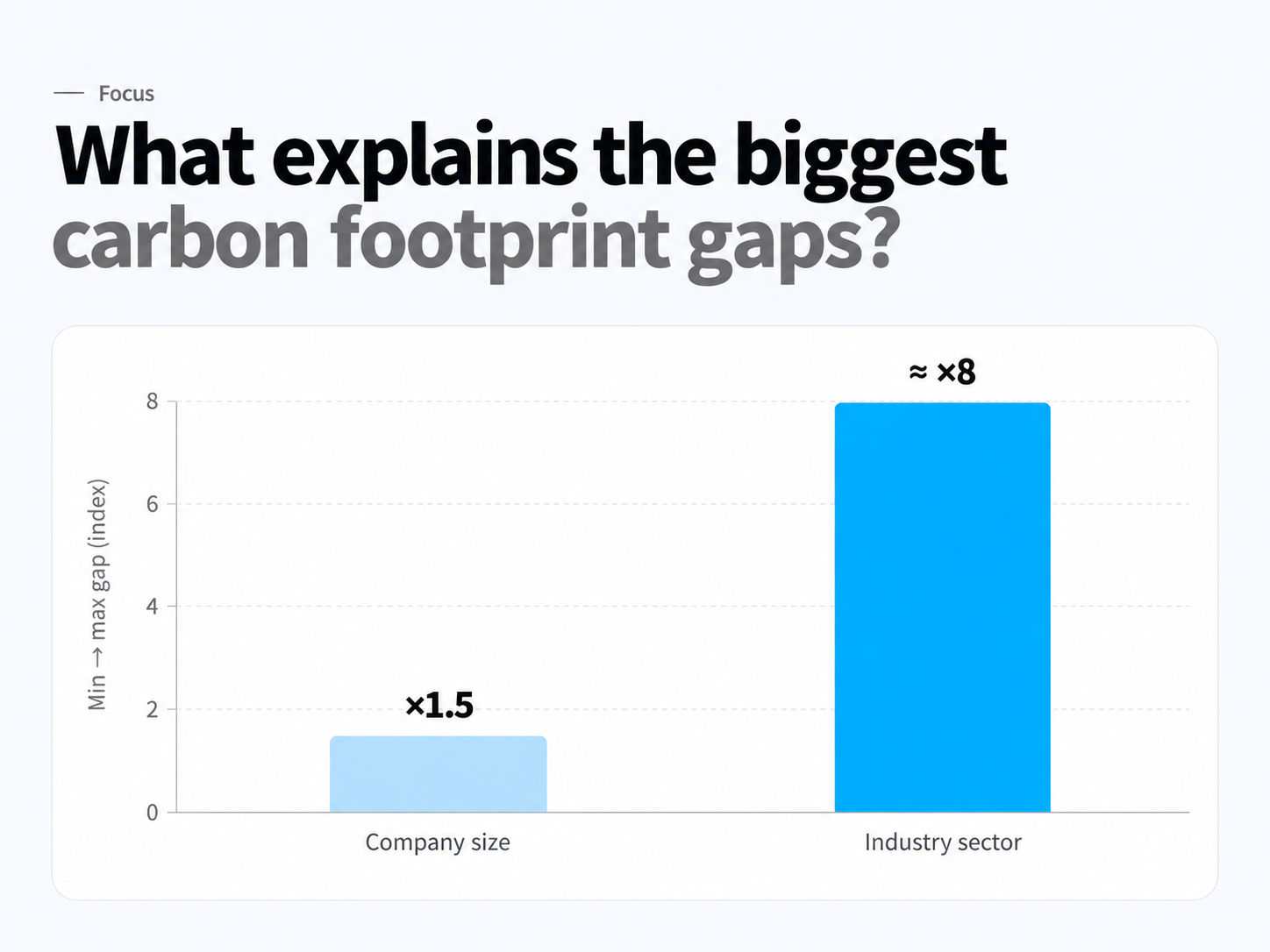
Company size ultimately explains relatively little of the difference in emissions: the variation in carbon footprint per traveller between different company-size categories remains fairly limited.
By contrast, the difference between the highest- and lowest-emitting industries approaches a factor of eight. Industries that require more international travel and flights naturally have a much higher carbon footprint than sectors where mobility is mainly local or rail-based.
For a company, comparing its carbon footprint only with a national average can therefore be misleading. Industry sector provides a much more relevant benchmark.
Do international business trips really generate more carbon emissions?
Yes, and the difference between the number of trips and their carbon impact is particularly significant.
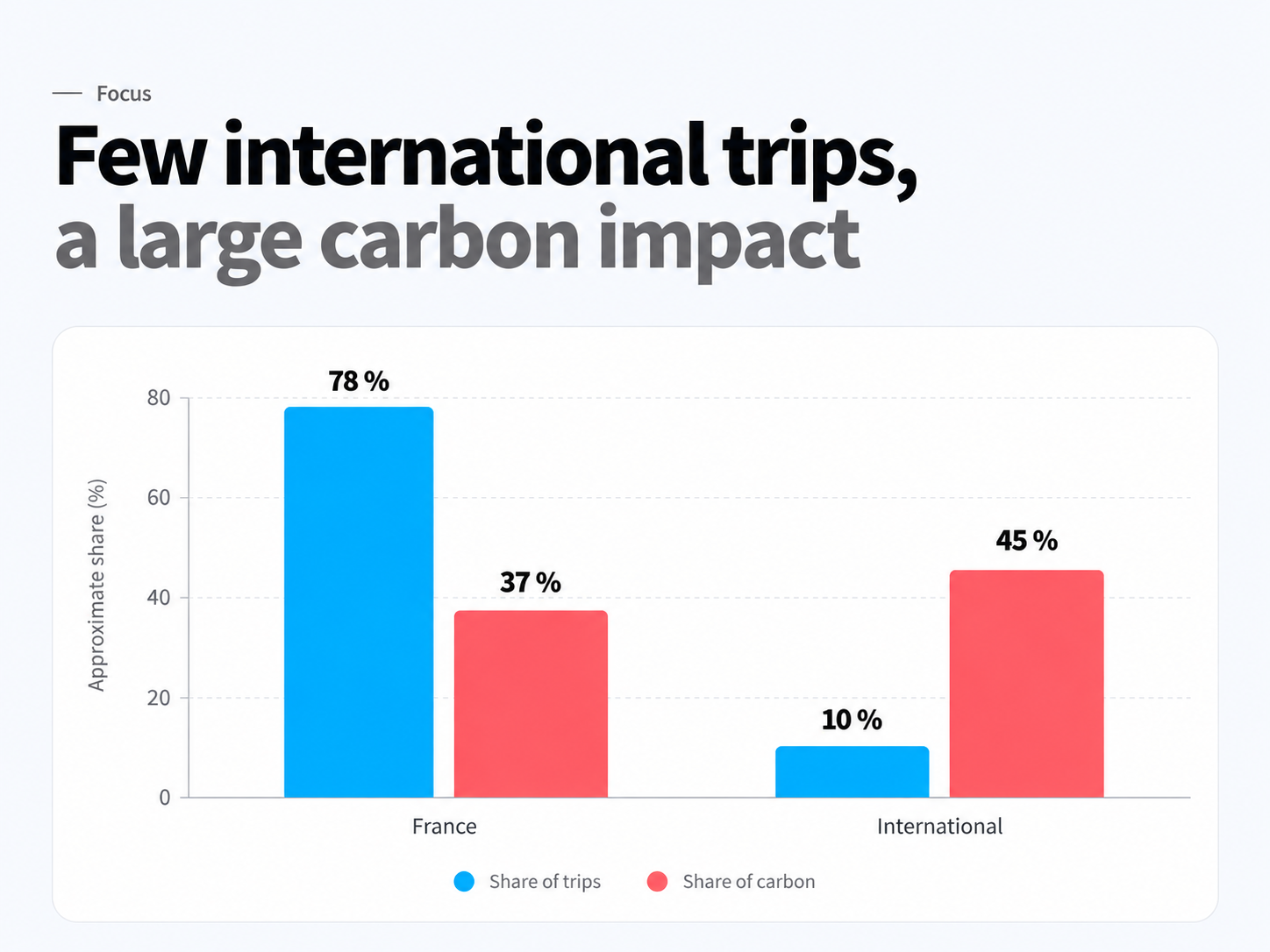
Trips within France account for the large majority of journeys in the Fairjungle panel, but a much smaller share of total emissions.
By contrast, international business travel represents around one trip in ten, yet accounts for almost half of the carbon footprint analysed.
This imbalance shows why the number of trips alone is not enough to assess the environmental impact of a corporate Travel programme: distance and mode of transport are critical factors.
Air or rail: what is the biggest opportunity for reducing emissions from short-distance business travel?
Modal shift is one of the most immediate ways to reduce business travel emissions.
For journeys of less than 1,000 kilometres, rail is already by far the most widely used mode of transport. However, around one in six short-distance trips is still made by air.
This small proportion of flights generates significantly more carbon than equivalent rail journeys.
For companies, identifying routes where rail is a realistic alternative therefore provides a direct way to reduce the carbon footprint of a Travel programme without necessarily reducing the number of business trips.
Why do some companies generate much more business travel carbon than others?
The carbon footprint of a Travel programme depends less on the number of employees than on how they travel.
The combination of travel volume, distance travelled and mode of transport creates very different carbon profiles from one organisation to another.
The Carbon Barometer shows, for example, that some industries travel frequently but make greater use of rail, while others make fewer trips but rely heavily on long-haul flights.
Two companies with a similar volume of business travel can therefore have very different carbon intensities.
How can a company benchmark its business travel carbon footprint?
An overall average provides a useful first reference point, but it is not enough.
To properly understand the carbon performance of its business travel programme, a company should ideally examine several dimensions:
carbon footprint per active traveller;
industry sector;
the mix between air, rail, hotel and car;
the share of international business travel;
the use of air travel for short-distance journeys;
carbon intensity per kilometre travelled.
This approach makes it possible to distinguish emissions linked to the overall volume of travel from those linked to transport choices.
What does the 2026 Business Travel Carbon Barometer reveal?
Fairjungle’s 2026 Business Travel Carbon Barometer analyses emissions from several hundred companies in order to provide practical benchmarks for Travel Managers, sustainability teams and Finance departments.
The full study includes:
average carbon footprint per business traveller;
differences in emissions according to company size;
differences between industry sectors;
carbon intensity per kilometre by industry;
the distribution of emissions between air travel, hotels, rail and cars;
the impact of domestic, European and international business travel;
the share of air travel on journeys of less than 1,000 km;
the different carbon profiles of companies.
The calculations are based on ICAO methodologies for air travel and ADEME methodologies for other travel categories.