Hotel accommodation represents a significant share of business travel budgets. But how much should companies actually budget for hotel stays in France in 2026?
Based on tens of thousands of hotel bookings made by business travellers across France, we analysed the main trends shaping the B2B hotel market: average prices, differences between cities, seasonality, length of stay, and weekday versus weekend pricing.
The first key takeaway is clear: behind an overall stable market, hotel prices vary significantly depending on the destination and the timing of the trip.
What hotel budget should companies plan for business travel in France?
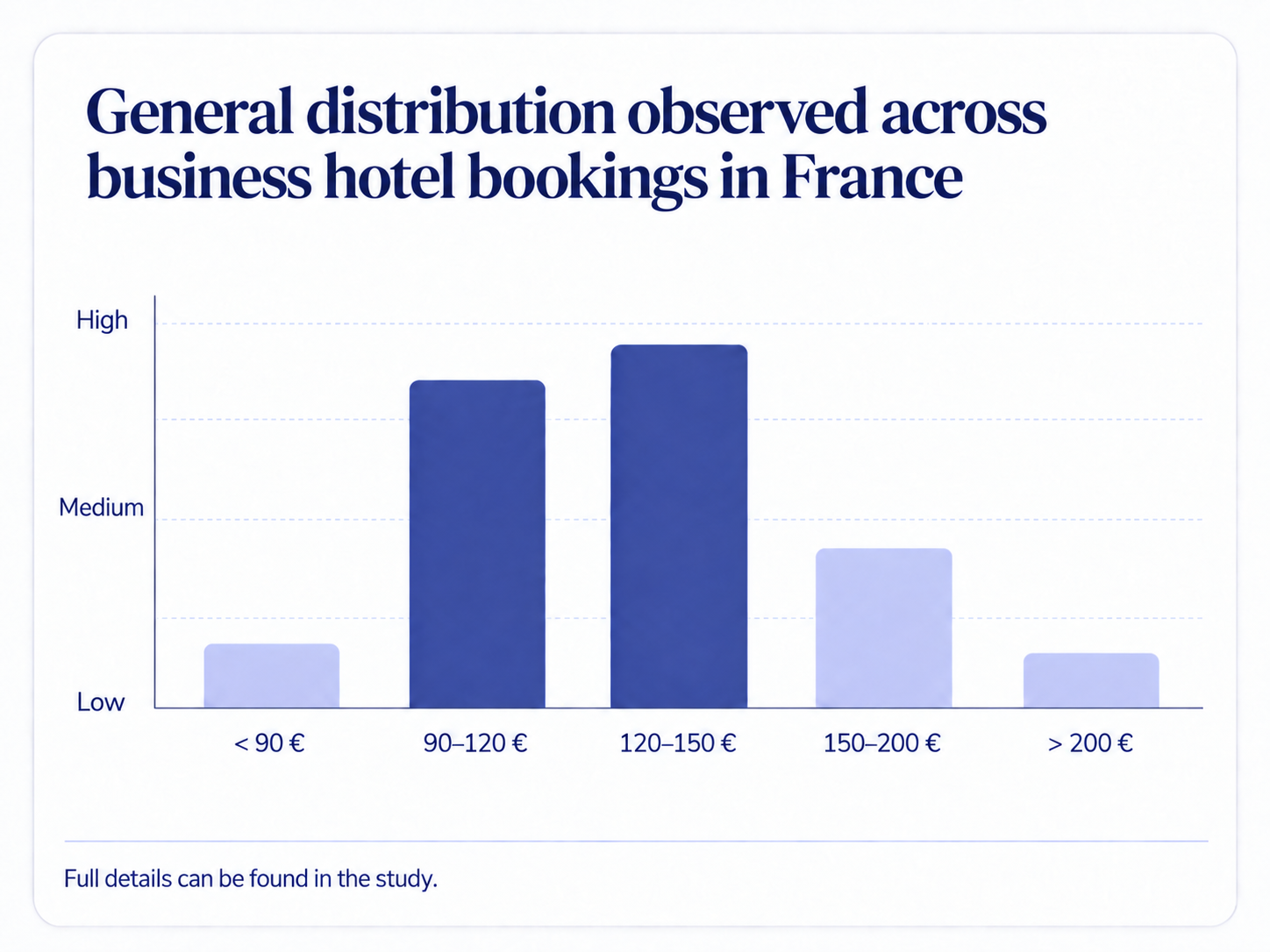
Most business hotel bookings remain concentrated in the mid-range segment, with a large share of stays falling between approximately €100 and €150 per night.
Bookings significantly above €200 per night remain relatively uncommon.
However, national averages should be interpreted with caution.
The French business hotel market is far from homogeneous: a hotel night in a major metropolitan area can cost significantly more than in a smaller city.
For companies, applying a single hotel spending cap across the whole country can therefore quickly become unsuitable.
Which cities are the most expensive for business travel in France?
Unsurprisingly, Paris remains well above the rest of the French market.
More importantly, the analysis shows that hotel price differences between major French cities can range from almost one to two. Some large metropolitan areas operate as premium hotel markets, while many other business destinations fall within a much more consistent price range.
This geographic disparity raises an important question for corporate travel policies.
Should companies apply the same hotel cap in Paris, Lyon, Toulouse and Nantes? Or should limits be adjusted according to the actual hotel prices observed in each market?
The full ranking of major French cities makes it possible to compare these differences in detail.
When are hotels most expensive for business travellers in France?
The timing of a business trip also has a significant impact on hotel prices.
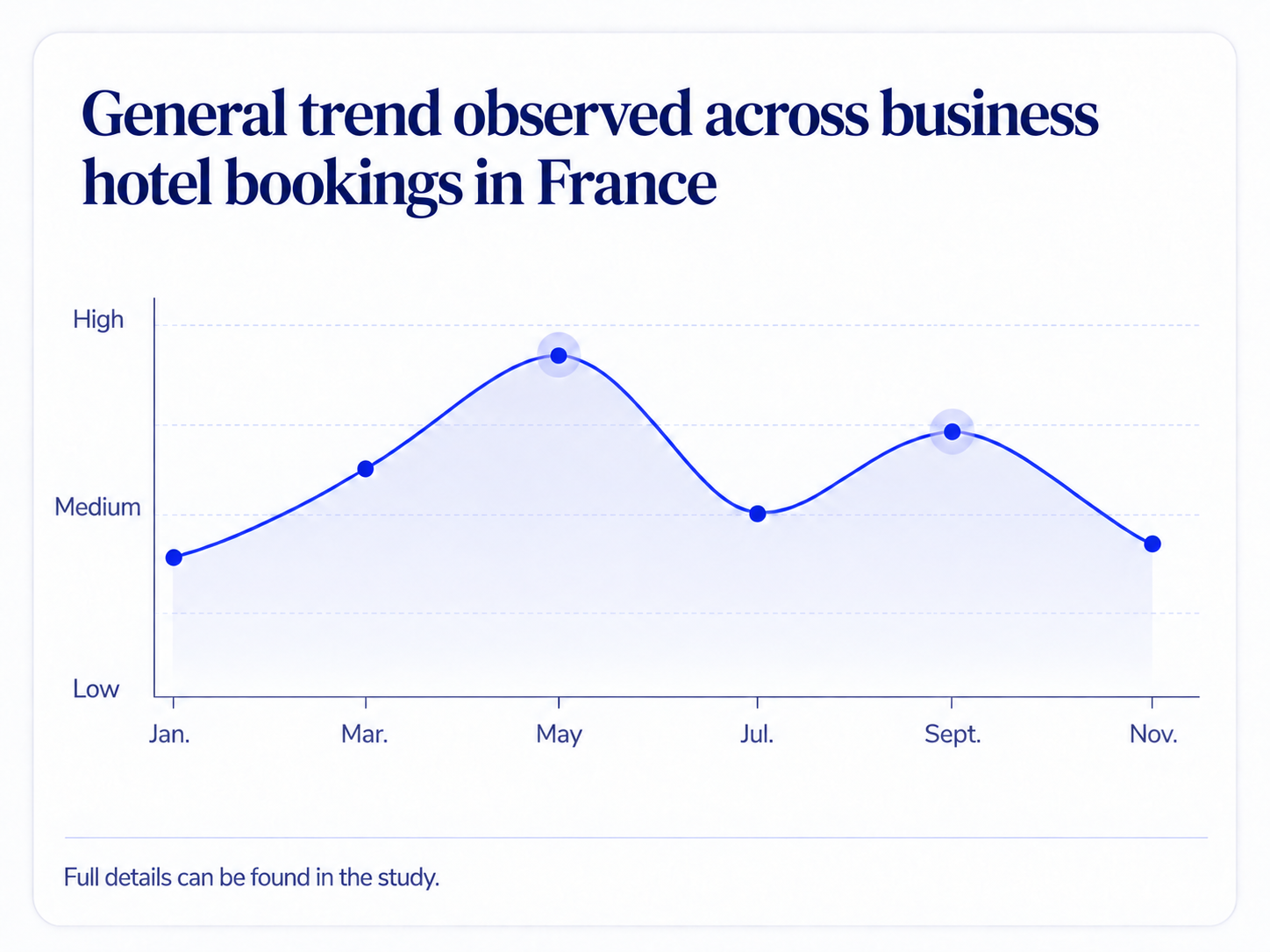
The data shows a relatively consistent seasonal pattern across major French cities: hotel rates tend to increase during spring, fall during the summer, and rise again around September.
For companies, this means that a hotel spending cap that works well during a quieter period may become much harder to respect only a few months later.
A travel policy that accurately reflects market conditions should therefore take into account not only the destination, but also seasonality.
Are hotels cheaper at weekends for business travellers?
Not necessarily.
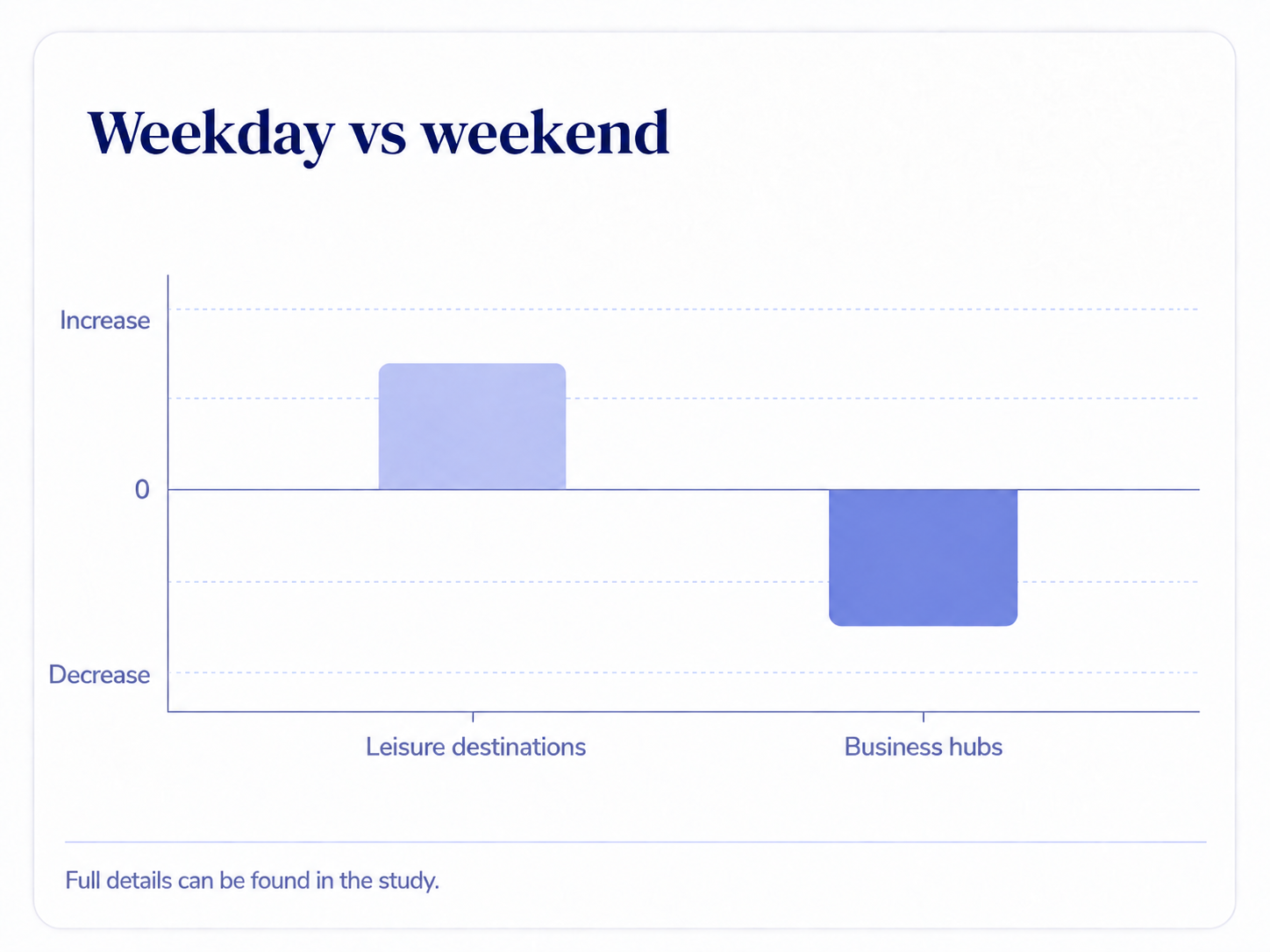
At national level, weekday and weekend prices remain relatively close. However, this average hides two very different patterns.
In some strongly business-oriented destinations, hotel rates fall noticeably at weekends when corporate demand decreases. In contrast, more leisure-oriented destinations can become more expensive as leisure travellers replace business travellers.
For business trips with some date flexibility, choosing the right days to stay can therefore become a useful cost-optimisation lever.
Do longer business trips result in lower hotel rates?
It may seem logical to assume that a longer hotel stay automatically leads to a better nightly rate.
However, the data suggests that the impact of length of stay remains relatively limited.
Meaningful savings tend to appear only on the longest stays. In most cases, the choice of hotel therefore has a much greater impact on price than the number of nights booked.
For companies looking to reduce travel costs, this is an important insight: optimising hotel sourcing and property selection may have more impact than relying solely on longer-stay discounts.
Are business hotel prices increasing in France in 2026?
Another important finding is that hotel prices are not increasing uniformly across the French market.
When comparing similar properties, observed rates remain broadly stable between early 2025 and early 2026.
However, this national stability once again hides significant local differences. Some cities are experiencing noticeable price increases, while others are seeing hotel rates decline.
For Travel Managers, monitoring average hotel inflation at national level is therefore no longer enough. Destination-level pricing provides a much more relevant benchmark.
How should companies adapt their hotel travel policy in 2026?
The data highlights a simple conclusion: there is no single hotel rate that accurately represents the entire French business travel market.
Destination, season, day of stay and even traveller profile can all have a meaningful impact on the final hotel price.
A corporate travel policy that is too uniform may therefore either restrict bookings unnecessarily or allow spending above actual market conditions.
The challenge is to introduce hotel spending limits that reflect market conditions, taking into account both the destination and changes in hotel prices over time.
How much do business hotels really cost in your city?
Our 2026 study analyses hotel bookings from hundreds of companies and thousands of business travellers across France’s main business destinations.
It reveals, among other things:
which French cities have the highest business hotel prices;
how hotel prices vary between major destinations;
the most expensive periods of the year;
the real impact of length of stay;
the difference between weekday and weekend hotel rates;
the main hotel pricing changes observed between 2025 and 2026.